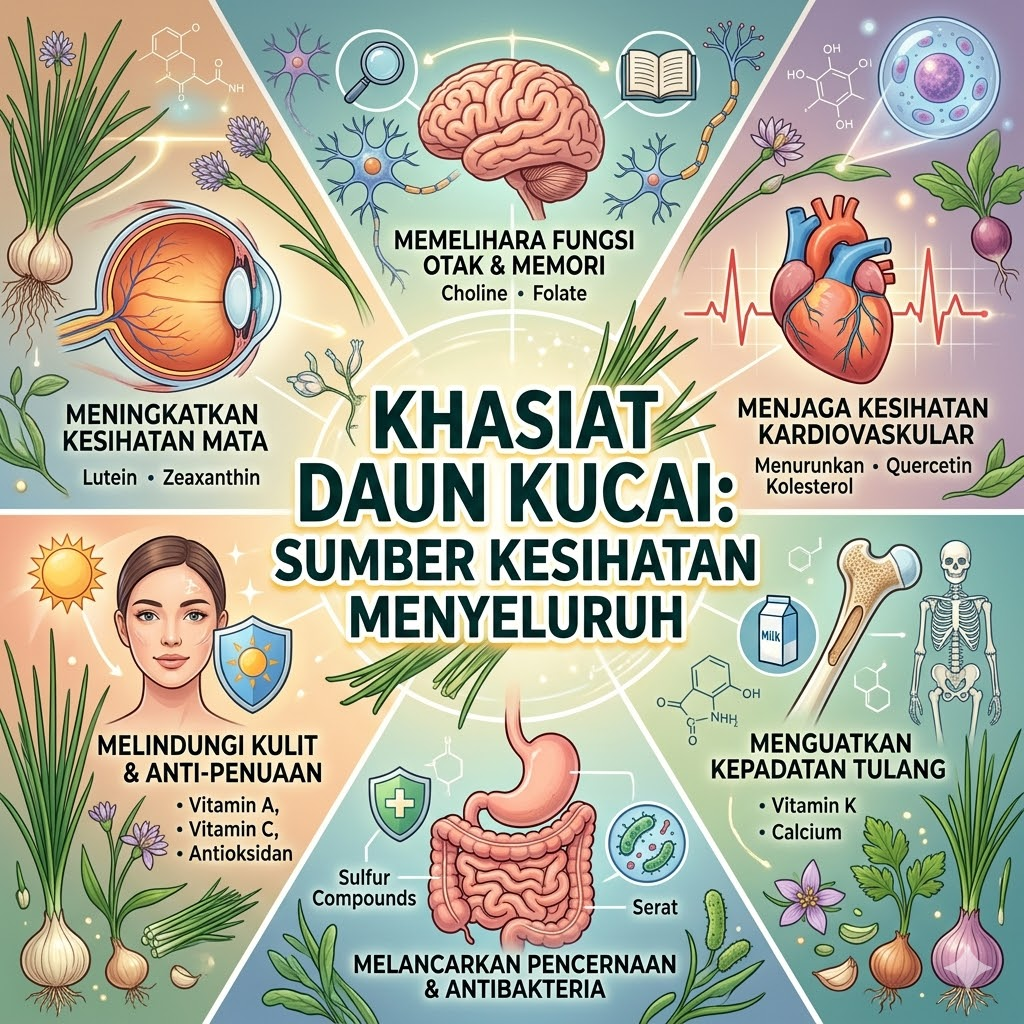
Daun kucai termasuk genus Allium (satu keluarga dengan bawang dan bawang putih) dan banyak diteliti sebagai sayuran fungsional. Penelitian terutama masih pada uji laboratorium, hewan coba, dan analisis komposisi gizi, bukan uji klinis manusia.
Kandungan Gizi & Senyawa Aktif
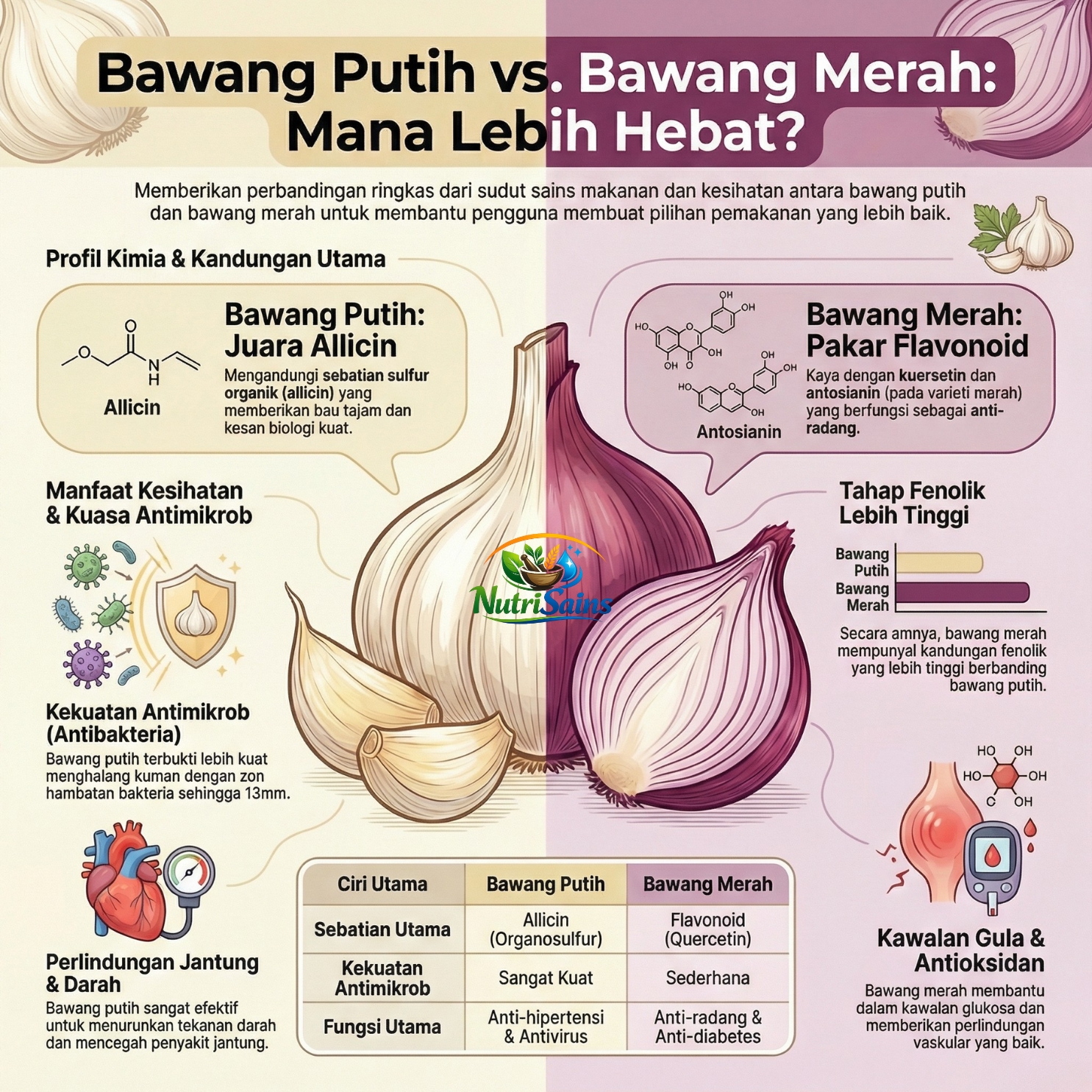
- Kucai kaya protein, serat, kalium, kalsium, zat besi, serta mineral lain dan senyawa sulfur beraroma seperti allicin dan allyl methyl thiosulfinate (Devi et al., 2024; Gavhane et al., 2024; Khalid et al., 2014).
- Mengandung banyak fenol dan flavonoid (rutin, quercetin, klorogenat, dll.), alkaloid, saponin, tanin, terpenoid dan coumarin (Talukdar et al., 2023; Nhut et al., 2020; Sharma & Sharma, 2017; Khalid et al., 2014; Mukemre, 2024).
Contoh kandungan dan aktivitas
| Kandungan utama | Manfaat laboratorium yang terkait | Sumber |
|---|---|---|
| Fenol & flavonoid tinggi | Aktivitas antioksidan kuat | (Kalasee & Mittraparp-Arthorn, 2023; Devi et al., 2024; Talukdar et al., 2023; Tanowijono et al., 2025; Nhut et al., 2020; Sharma & Sharma, 2017; Khalid et al., 2014) |
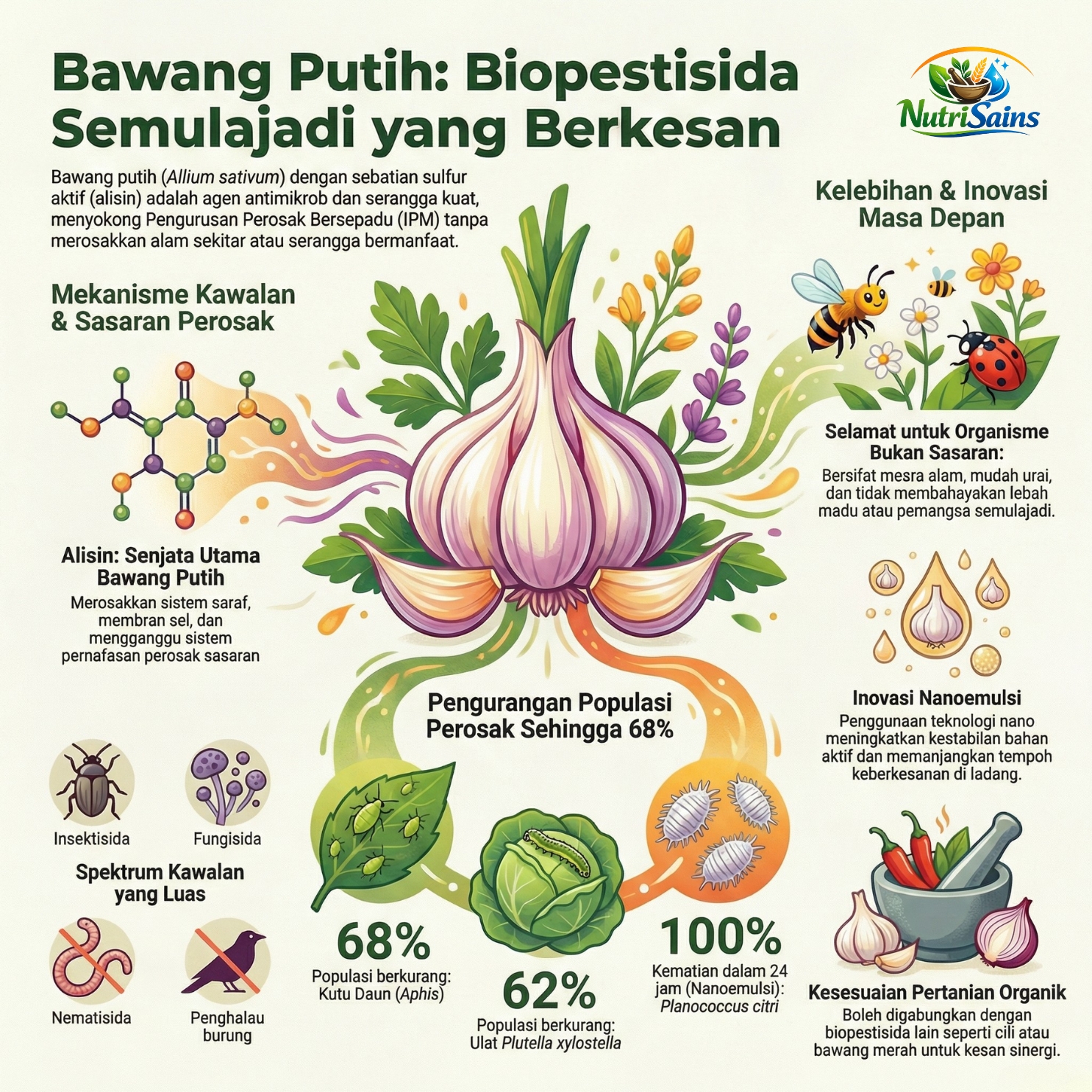
| Senyawa sulfur (allicin, organosulfur lain) | Sifat antimikroba, potensi kardioprotektif | (Devi et al., 2024; Wang et al., 2022; Gavhane et al., 2024; Khalid et al., 2014; Mukemre, 2024) |
| Serat & mineral (K, Ca, Fe) | Mendukung gizi, kesehatan jantung & tulang | (Devi et al., 2024; Gavhane et al., 2024; Khalid et al., 2014) |
Figure 1: Kandungan utama daun kucai dan efek lab terkait
Aktivitas Antioksidan & Antibakteri
- Ekstrak daun kucai (air, etanol, metanol) menunjukkan aktivitas antioksidan kuat dengan berbagai uji (DPPH, ABTS, FRAP, TEAC) (Kalasee & Mittraparp-Arthorn, 2023; Devi et al., 2024; Talukdar et al., 2023; Tanowijono et al., 2025; Nhut et al., 2020; Nath et al., 2022; Sharma & Sharma, 2017; Khalid et al., 2014).
- Dapat menangkap radikal bebas dan mereduksi ion besi, sehingga berpotensi melawan stres oksidatif (Kalasee & Mittraparp-Arthorn, 2023; Talukdar et al., 2023; Tanowijono et al., 2025; Nath et al., 2022; Mukemre, 2024).
- Ekstrak kucai menghambat berbagai bakteri patogen pangan seperti Staphylococcus aureus, Bacillus cereus, Salmonella, Listeria, E. coli, Vibrio (Kalasee & Mittraparp-Arthorn, 2023; Devi et al., 2024; Khalid et al., 2014).
Khasiat Farmakologis pada Model Hewan / In Vitro
- Antidiabetik: Ekstrak kucai menghambat enzim α‑amilase di uji tabung, mendukung potensi antidiabetes dan pengaturan gula darah (Talukdar et al., 2023; Mukemre, 2024).
- Antihiperlipidemik: Pada tikus hiperlipidemia, ekstrak etanol daun kucai menurunkan kolesterol total, trigliserida, LDL dan memperbaiki profil lipid (Iskandar, 2017).
- Analgesik (pereda nyeri): Ekstrak etanol daun kucai dosis 3,6–14,4 mg pada tikus menunjukkan efek analgesik pada uji hot‑plate, terbaik pada dosis tertinggi; masih lebih lemah dari parasetamol (Turama et al., 2020).
- Antikanker (awal): Skrining in silico menemukan senyawa americine dari kucai yang dapat berikatan kuat dengan target kanker paru (EGFR, B‑Raf, K‑Ras, PI3K) dan memiliki profil “drug‑like” (Nath et al., 2022).
Keamanan & Cara Konsumsi
- Ekstrak daun kucai dalam uji toksisitas larva udang menunjukkan toksisitas rendah (Tanowijono et al., 2025).
- Ekstrak kucai mentah dapat bersifat toksik pada sel hati dan ginjal tikus di kultur, namun menjadi aman setelah pemanasan, sejalan dengan kebiasaan mengonsumsi kucai matang (Gao et al., 2017).
Conclusion
Secara ilmiah, daun kucai kaya gizi, antioksidan, dan senyawa antibakteri, dengan bukti awal khasiat antidiabetik, penurun lemak darah, pereda nyeri, dan potensi antikanker dari studi laboratorium dan hewan. Namun, bukti klinis pada manusia masih sangat terbatas, sehingga kucai paling aman dipandang sebagai sayuran sehat pendukung, bukan pengganti obat. Mengonsumsinya dalam bentuk matang tampak lebih aman dibanding mentah berdasarkan data toksikologi sel.
These search results were found and analyzed using Consensus, an AI-powered search engine for research. Try it at https://consensus.app. © 2026 Consensus NLP, Inc. Personal, non-commercial use only; redistribution requires copyright holders’ consent.
References
Devi, P., Dhall, R., & Brar, J. (2024). Nutritional and Bioactive Compounds, Antioxidant Properties and Antibacterial Activity of Chinese Chive (Allium odorum L.). Plant Foods for Human Nutrition, 80. https://doi.org/10.1007/s11130-024-01259-7
Gao, Q., Li, X., Sun, J., Xia, E., Tang, F., Cao, H., & Xun, H. (2017). Isolation and identification of new chemical constituents from Chinese chive (Allium tuberosum) and toxicological evaluation of raw and cooked Chinese chive.. Food and chemical toxicology : an international journal published for the British Industrial Biological Research Association, 112, 400-411. https://doi.org/10.1016/j.fct.2017.02.011
Gavhane, A., Kale, R., Khade, Y., Bhandari, H., Gaikwad, S., Singh, S., P., S., Garde, Y., Khandagale, K., & Mahajan, V. (2024). Cultivation viability of Allium tuberosum L. in the Western Ghats: insights into crop dynamics, yield and quality. Frontiers in Plant Science, 15. https://doi.org/10.3389/fpls.2024.1480510
Iskandar, Y. (2017). EVALUATION OF PHYTOCHEMICAL AND ANTIHYPERLIPIDEMIC ACTIVITY OF ETHANOLIC EXTRACT OF ALLIUM TUBEROSUM ROTTLER LEAVES IN HYPERLIPIDEMIC WISTAR RATS. , 1, 106-106.
Kalasee, B., & Mittraparp-Arthorn, P. (2023). Phytochemicals, Antioxidant, and Antibacterial Activities of Fresh and Dried Chinese Chive (Allium tuberosum Rottler) Leaf Extracts. ASEAN Journal of Scientific and Technological Reports. https://doi.org/10.55164/ajstr.v26i4.249336
Khalid, N., Ahmed, I., Latif, M., Rafique, T., & Fawad, S. (2014). Comparison of antimicrobial activity, phytochemical profile and minerals composition of garlic Allium sativum and Allium tuberosum. Journal of the Korean Society for Applied Biological Chemistry, 57, 311-317. https://doi.org/10.1007/s13765-014-4021-4
Mukemre, M. (2024). Wild-Edible Allium Species from Highlands of Eastern Anatolia: Phytochemical Composition and In Vitro Biological Activities. Plants, 13. https://doi.org/10.3390/plants13141949
Nath, R., Singha, S., Nath, D., Das, G., Patra, J., & Talukdar, A. (2022). Phytochemicals from Allium tuberosum Rottler ex Spreng Show Potent Inhibitory Activity against B-Raf, EGFR, K-Ras, and PI3K of Non-Small Cell Lung Cancer Targets. Applied Sciences. https://doi.org/10.3390/app122211749
Nhut, P., An, T., Minh, L., Trúc, T., & Anh, N. (2020). Phytochemical screening of Allium Tuberosum Rottler. ex Spreng as food spice. IOP Conference Series: Materials Science and Engineering, 991. https://doi.org/10.1088/1757-899x/991/1/012021
Sharma, R., & Sharma, S. (2017). Evaluation of phytochemicals in some indigenous aromatic medicinal plants of North-East India. , 5, 42-47.
Talukdar, N., Das, K., Moirangthem, K., & Barman, I. (2023). Evaluation of In-vitro Anti-oxidant and α-amylase inhibition activity of Allium tuberosom and its Phytochemical analysis. Research Journal of Pharmacy and Technology. https://doi.org/10.52711/0974-360x.2023.00326
Tanowijono, G., Hendrawan, S., & Ferdinal, F. (2025). Analisis Fitokimia, Aktivitas Antioksidan dan Toksisitas Ekstrak Metanol Daun Kucai (Allium schoenoprasum) secara In Vitro. Jurnal Ilmiah Biologi UMA (JIBIOMA). https://doi.org/10.31289/jibioma.v7i2.6682
Turama, D., Bodhi, W., & Jayanto, I. (2020). UJI EFEK ANALGESIK EKSTRAK ETANOL DAUN KUCAI (Allium tuberosum) PADA TIKUS PUTIH JANTAN (Rattus norvegicus). PharmacoEconomics, 9, 413. https://doi.org/10.35799/pha.9.2020.30026
Wang, C., Zhang, J., Lv, J., Li, J., Gao, Y., Patience, B., Niu, T., Yu, J., & Xie, J. (2022). Effect of Methyl Jasmonate Treatment on Primary and Secondary Metabolites and Antioxidant Capacity of the Substrate and Hydroponically Grown Chinese Chives. Frontiers in Nutrition, 9. https://doi.org/10.3389/fnut.2022.859035